
 By Shukla Dhaval
Introduction
Adaptive Cruise Control has become a key feature in modern vehicles that aim to improve driving comfort and safety. The Adaptive Cruise Control system extends the concept of traditional cruise control by adjusting vehicle speed automatically based on surrounding traffic conditions. Drivers no longer need to constantly adjust the throttle when traffic changes. The system monitors the road ahead and responds by accelerating or slowing the vehicle. This technology reduces driver workload while supporting smoother travel during long highway journeys.
Modern transportation systems require intelligent technologies that can help drivers maintain safe distances from other vehicles. Adaptive Cruise Control supports this goal through advanced sensors and digital processing systems. By continuously measuring distance and speed of nearby vehicles, the system reacts quickly when traffic conditions change. Drivers gain improved comfort during travel while the vehicle maintains a safe gap from vehicles ahead. The system also promotes steady driving behavior that improves fuel efficiency and reduces sudden braking events.

Adaptive Cruise Control
Adaptive Cruise Control allows a vehicle to automatically adjust its speed to maintain a safe distance from traffic ahead. The system works through sensors mounted at the front of the vehicle that constantly monitor the road environment. When a slower vehicle appears ahead, the system reduces speed automatically. When the road clears, the vehicle returns to the preset speed chosen by the driver. This automatic adjustment improves driving convenience during highway travel.
The Adaptive Cruise Control system manages throttle input and limited braking through electronic communication with the engine and braking modules. Radar sensors or infrared sensors track the distance between vehicles. A control unit analyzes this information and determines the required speed adjustments. The system then sends signals to the engine or braking system. This process happens continuously while the system remains active. Drivers remain responsible for monitoring road conditions while the technology supports speed management.
The Basics of Adaptive Cruise Control
Adaptive cruise control improves traditional cruise control by responding automatically to traffic conditions. Conventional cruise control maintains a constant speed selected by the driver. Traffic changes require manual braking or acceleration in such systems. Adaptive Cruise Control removes this limitation by analyzing the distance between vehicles and adjusting speed automatically. Drivers gain greater convenience during long highway drives where traffic flow changes frequently.
The system combines several technologies including radar sensors, cameras, and electronic control modules. Sensors detect vehicles ahead and calculate the distance between vehicles. The onboard computer evaluates this information many times each second. When the distance becomes smaller than the selected gap, the system reduces speed gradually. When traffic clears, the system accelerates back to the chosen speed. This intelligent behavior helps maintain consistent traffic flow.
Radar and Sensor Technology
Radar sensors form the core sensing element of most Adaptive Cruise Control systems. These sensors emit electromagnetic waves that travel toward objects ahead of the vehicle. When the waves strike another vehicle, they reflect back toward the sensor. The system measures the time required for the signal to return. Using this information, the system calculates the distance between vehicles accurately.
Many vehicles combine radar sensors with additional technologies such as cameras or lidar units. These components improve the ability to detect vehicles, motorcycles, and other objects on the road. The control system processes this information using complex algorithms. The vehicle then determines how quickly it should adjust speed. These sensing technologies allow Adaptive Cruise Control to function reliably under varying driving conditions.
Dynamic Speed Adjustment
Dynamic speed adjustment allows the vehicle to respond smoothly to traffic behavior. When a slower vehicle enters the lane ahead, the system gradually reduces throttle input. If necessary, it applies light braking to maintain the selected following distance. This process avoids sudden braking events and maintains smooth vehicle movement.
Once the path becomes clear again, the system accelerates the vehicle until it reaches the previously set cruise speed. The acceleration occurs smoothly to maintain comfort and stability. Drivers can continue focusing on steering while the system manages speed adjustments. This feature proves especially useful during long highway journeys where traffic speed changes frequently.
User Defined Settings
Adaptive Cruise Control systems allow drivers to select their preferred following distance. Most systems provide several distance levels that represent time gaps between vehicles. A shorter gap allows closer driving distance, while a larger gap increases safety margin. Drivers select the gap based on personal comfort and traffic conditions.
The control unit calculates the appropriate speed required to maintain the selected distance. If the vehicle ahead slows down, the system reduces speed to maintain the chosen gap. When traffic speeds increase, the system accelerates accordingly. This customization allows drivers to maintain comfort while benefiting from automated speed control.
Stop and Go Capability
Advanced Adaptive Cruise Control systems include stop and go capability designed for heavy traffic conditions. This feature allows the vehicle to slow down until it reaches a complete stop when traffic stops ahead. When traffic begins moving again, the system automatically accelerates the vehicle.
This feature greatly improves driving comfort during congested urban traffic. Drivers no longer need to constantly press the brake pedal and accelerator in slow moving traffic. The system handles speed control while the driver supervises vehicle movement. This feature represents an important step toward automated driving assistance.
Benefits of Adaptive Cruise Control
Enhanced Safety
Adaptive Cruise Control supports safer driving by maintaining a consistent distance from vehicles ahead. The system reacts quickly when traffic speed changes. This automatic response helps prevent sudden collisions caused by delayed driver reactions. Maintaining a safe distance reduces the likelihood of rear end accidents.
The system also assists drivers during long journeys when fatigue may reduce reaction speed. Continuous monitoring of surrounding vehicles allows the system to respond immediately to changes in traffic flow. Drivers still supervise vehicle operation while the technology supports safe driving behavior.
Reduced Driver Fatigue
Driving long distances often requires constant adjustments to maintain safe speed. Adaptive Cruise Control reduces this effort by managing acceleration and deceleration automatically. Drivers experience less stress during extended highway travel. This comfort allows drivers to maintain focus on road awareness.
The system performs repetitive speed adjustments that would otherwise require continuous driver attention. Removing these small tasks helps reduce mental fatigue. Drivers remain engaged with the driving process while experiencing greater comfort during travel.
Optimized Fuel Efficiency
Adaptive Cruise Control can improve fuel efficiency through smooth acceleration and deceleration patterns. Sudden throttle changes increase fuel consumption in many vehicles. The system controls speed adjustments gradually, which allows the engine to operate more efficiently.
Steady vehicle speed also reduces unnecessary braking events. This behavior conserves energy and supports efficient driving patterns. Drivers benefit from reduced fuel usage while maintaining comfortable travel speeds.
Convenience in Traffic
Traffic congestion often requires frequent braking and acceleration. Adaptive Cruise Control simplifies this process by managing speed adjustments automatically. Drivers can focus on steering and surrounding road conditions while the system controls speed.
Stop and go functionality further improves convenience during traffic jams. Vehicles equipped with this feature slow down, stop, and move again automatically. This capability makes urban commuting more comfortable and less stressful for drivers.
How Does It Work
The Adaptive Cruise Control system processes information from sensors to determine vehicle speed adjustments. A radar headway sensor sends signals to a digital processing unit that interprets distance and speed information. The controller calculates whether the vehicle should maintain speed or reduce speed. When a slower vehicle appears ahead, the system sends commands to the engine or braking system.
The system continues monitoring traffic conditions during operation. If the road becomes clear again, the controller commands the vehicle to accelerate until it reaches the preset speed. This cycle repeats continuously while the system remains active. Drivers maintain steering control while the system manages speed.
Some systems also use infrared sensors to detect vehicles ahead. Each sensor includes an emitter that sends infrared light toward objects ahead. A receiver collects reflected light and measures distance. Combining multiple sensors improves detection accuracy and system reliability.
System Inputs
- System on/off: If on, denotes that the cruise-control system should maintain the car speed.
- Engine on/off: If on, denotes that the car engine is turned on; the cruise control system is only active if the engine is on.
- Pulses from wheel: A pulse is sent for every revolution of the wheel.
- Accelerator: Indication of how far the accelerator has been pressed.
- Brake: On when the brake is pressed; the cruise-control system temporarily reverts to manual control if the brake is pressed.
- Increase/Decrease Speed: Increase or decrease the maintained speed; only applicable if the cruise-control system is on.
- Resume: Resume the last maintained speed; only applicable if the cruise control system is on.
- Clock: Timing pulse every millisecond.
System Output
- Throttle: Digital value for the engine throttle setting.
Adaptive Cruise Control Features
- Maintains a safe, comfortable distance between vehicles without driver interventions.
- Maintains a consistent performance in poor visibility conditions.
- Maintains a continuous performance during road turns and elevation changes.
- Alerts drivers by way of automatic braking.
Physical Layout
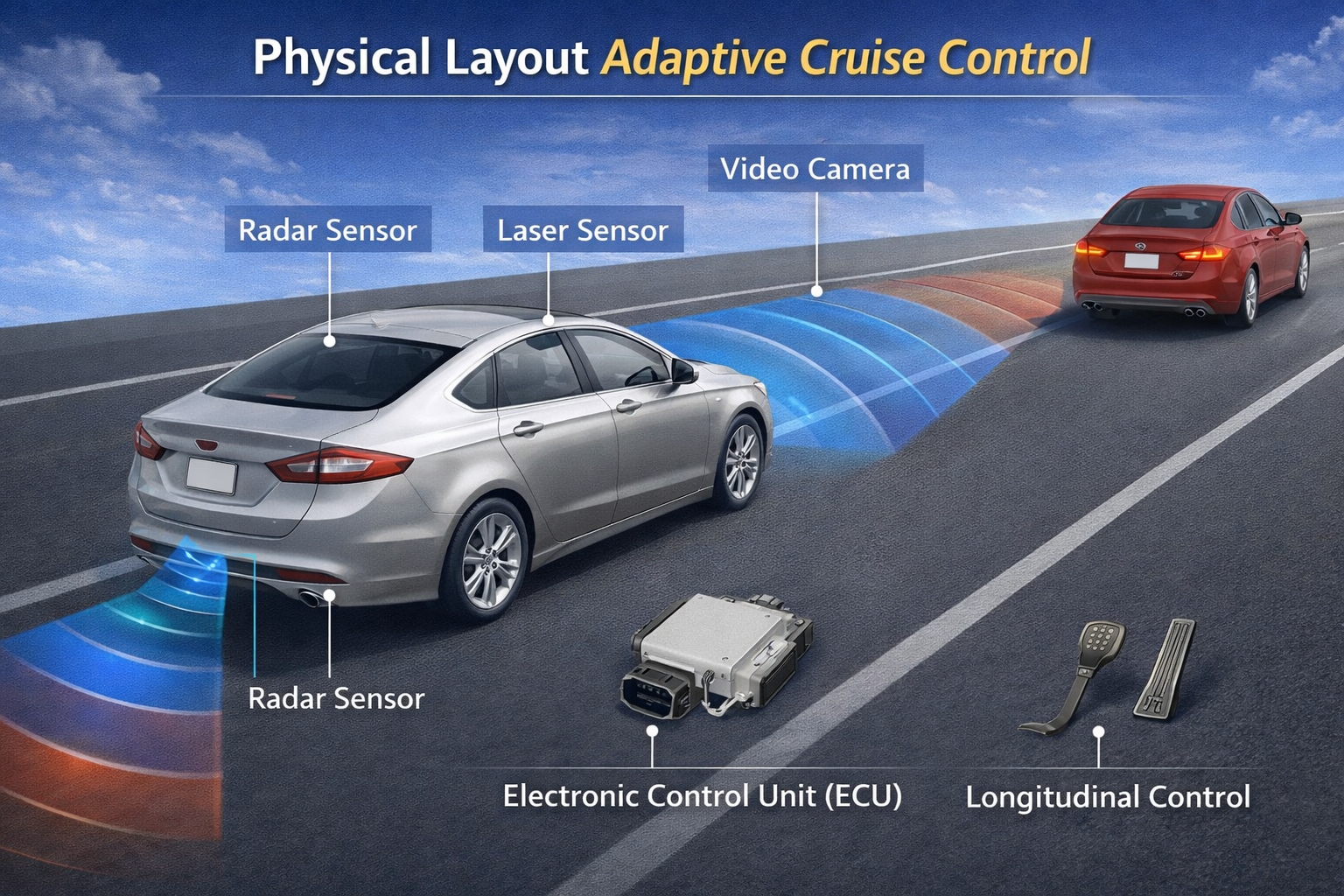
ACC Module
The ACC module processes sensor data and determines whether a vehicle appears ahead. When the system operates in time gap control mode, the module calculates the distance between vehicles. It sends commands to engine and brake control modules to maintain the selected gap.
Engine Control Module
The engine control module receives commands from the ACC module and adjusts the throttle accordingly. By increasing or decreasing throttle input, the system controls vehicle speed automatically.
Brake Control Module
The brake control module measures wheel speeds and applies braking force when requested by the ACC module. Electronic braking assistance allows smooth deceleration during speed adjustments.
Instrument Cluster
The instrument cluster displays system status and driver messages. It also processes signals from cruise control switches located on the steering wheel.
CAN Network
The Controller Area Network connects all electronic modules within the vehicle. The network allows modules to exchange information quickly and coordinate vehicle control functions.
Advantages
- The driver is relieved from the task of careful acceleration, deceleration and braking in congested traffics.
- A highly responsive traffic system that adjusts itself to avoid accidents can be developed.
- Since the braking and acceleration are done in a systematic way, the fuel efficiency of the vehicle is increased.
Disadvantages
- A cheap version is not yet realized.
- A high market penetration is required if a society of intelligent vehicles is to be formed.
- Encourages the driver to become careless. It can lead to severe accidents if the system is malfunctioning.
- The ACC systems yet evolved enable vehicles to cooperate with the other vehicles and hence do not respond directly to the traffic signals.
Conclusion
Adaptive Cruise Control represents a major advancement in modern driving assistance technology. The system allows vehicles to maintain safe distances from traffic while automatically adjusting speed. Drivers experience improved comfort during long journeys and heavy traffic conditions. The technology also supports smoother acceleration and braking patterns that improve fuel efficiency. As automotive systems continue evolving, Adaptive Cruise Control will remain an essential component of advanced driver assistance systems and future automated driving technologies.