
 Guru
GuruIntroduction
Kirchhoff’s Current Law (KCL) is one of the most fundamental principles used in electrical circuit analysis.Proposed by the German physicist Gustav Robert Kirchhoff in 1845, this law is based on the conservation of electric charge. It explains how electric current behaves at a junction or node in an electrical circuit and serves as a foundation for analyzing both simple and complex electrical networks.
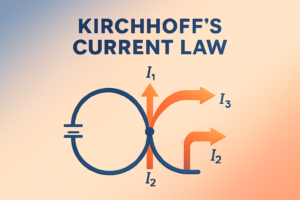
What is Kirchhoff’s Current Law?
Kirchhoff’s Current Law states that:
➤ At any node (junction) in an electrical circuit, the algebraic sum of currents is zero.
In simpler terms, the total current entering a junction is equal to the total current leaving the junction.This means that a node cannot store electric charge; whatever charge flows into it must flow out.
Mathematical Expression of KCL
KCL can be expressed mathematically as:
ΣI = 0
Or equivalently:
ΣIin = ΣIout
- Iin = currents entering the node
- Iout = currents leaving the node
Principles of Kirchhoff’s Current Law
Kirchhoff’s Current Law derives from the law of conservation of charge, which states that electric charge can neither be created nor destroyed. Therefore, at any node in an electrical circuit, the system must maintain charge balance.
For example, if 3 A enters a junction and 1 A and 2 A leave the junction, then:
3 A = 1 A + 2 A
Understanding KCL with Examples
Simple Junction Example
If current I1 = 5 A enters a node and currents I2 = 3 A and I3 = 2 A leave the node,then according to KCL:
5 A = 3 A + 2 A
Sign Convention in KCL
- Currents entering a node are considered positive
- Currents leaving a node are considered negative
Example:
+I1 + I2 − I3 − I4 = 0
Applying Kirchhoff’s Current Law in Circuit Analysis
- Identify all nodes in the circuit
- Label and assume directions of currents
- Apply KCL at each node
- Form algebraic equations
- Solve equations and verify current directions
Mathematical Application of KCL
In academic and professional applications, engineers use KCL to form simultaneous equations for circuits with multiple nodes. By solving these equations using algebra or matrix methods, they can determine unknown current values accurately.
Practical Example: Household Electrical Circuit
Kirchhoff’s Current Law widely applies in household wiring systems. Suppose 10 A enters a junction from a circuit breaker. If lighting systems consume 6 A, other appliances such as a television receive the remaining current of 4 A.
10 A = 6 A + 4 A
Visual Representation of Current Flow
| Branch | Current Direction | Current (A) |
|---|---|---|
| Branch 1 | Into Node | 3 A |
| Branch 2 | Out of Node | 1 A |
| Branch 3 | Out of Node | 2 A |
Applications of Kirchhoff’s Current Law
- Nodal analysis
- Electronic circuit design
- Operational amplifier and transistor circuits
- Power distribution systems
- Fault detection and troubleshooting
Limitations of Kirchhoff’s Current Law
- Assumes lumped circuit elements
- Less accurate for high-frequency circuits
- Does not account for electromagnetic field effects
Conclusion
Kirchhoff’s Current Law is an essential concept for understanding and analyzing current flow in electrical circuits.Its foundation in the conservation of charge makes it reliable for academic study, engineering design, and practical electrical applications. Mastering KCL enables accurate circuit analysis, safer designs, and efficient troubleshooting.